As homes and buildings become more connected, automation systems are no longer simply controlling lights. They can manage blinds, heating and cooling, energy, access control, CCTV, intercoms, security functions, audio and visual along with remote access. With that connectivity comes an important question:
How do you protect the automation system itself?
KNX Secure is security architecture designed to protect communication within an installation. It adds encryption, authentication, data integrity and protection against replayed messages, helping prevent unauthorised parties from reading, modifying or injecting KNX communications.
For a premium automation installation, this means security is not simply added around the outside of the system. It can be built into the communication between the devices themselves.
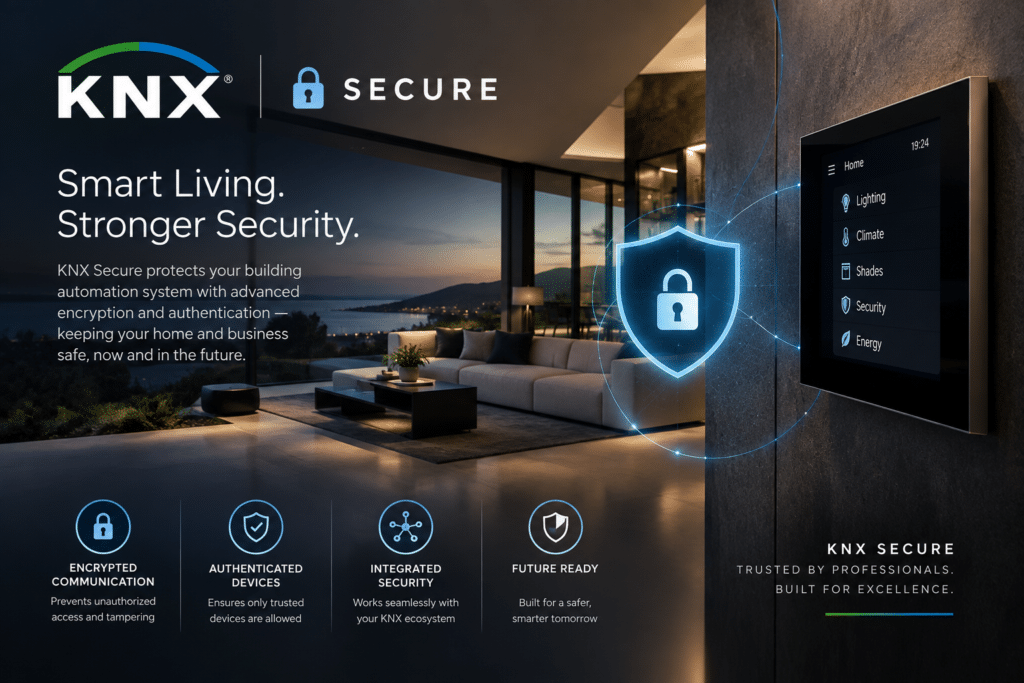
KNX Secure is an extension of the KNX standard that protects KNX communications using established cryptographic techniques, including AES-128 CCM encryption. It is designed to protect both the communication infrastructure and the information being exchanged between KNX devices.
There are two principal components:
KNX Data Secure protects the actual KNX data being exchanged between devices.
Unlike KNX IP Secure, Data Secure operates at the telegram/data level and can protect communications across KNX media such as twisted pair and RF, depending on the devices and configuration.
This allows individual functions or Group Addresses to be secured rather than requiring the entire installation to operate as one security domain.
KNX IP Secure protects KNX communication travelling over IP networks.
This is particularly important where KNX connects to an Ethernet network, multiple buildings, remote access infrastructure or other IP-based systems. KNX IP Secure encrypts the relevant IP communication and provides mechanisms for authentication, data integrity and freshness. This helps prevent an unauthorised device from simply connecting to the IP network and understanding or manipulating KNX traffic.
At its simplest, KNX Secure works by ensuring that KNX devices do not simply trust every message travelling across the system.
A secure communication process can be thought of in four stages:
1. Devices establish trusted credentials
KNX Secure devices have security credentials that are managed through ETS, the engineering and commissioning software used to configure KNX installations.
Each KNX Secure device has a unique Factory Default Setup Key (FDSK), which forms part of the device’s secure commissioning process. The device certificate contains information required to securely introduce the device into the KNX project.
This creates a foundation of trust between the engineering environment and the KNX Secure device.
2. Communication is encrypted
When KNX Secure is enabled, the relevant KNX telegram data is encrypted.
KNX Secure uses AES-128 CCM, combining encryption with mechanisms for authentication and data integrity.
In practical terms:
Someone who intercepts the communication should not simply be able to read the information contained within it.
For a building automation system, this is important because the information travelling through the system can reveal or control sensitive building functions.
3. Messages are authenticated
Encryption alone is not enough.
A secure system also needs to establish that a message actually came from an authorised source and has not been altered.
KNX Secure uses authentication mechanisms and Message Authentication Codes to help verify the integrity and authenticity of secure telegrams.
This means the system is concerned not only with:
“Can someone read this message?”
but also:
“Is this a legitimate message from an authorised device, and has it been changed?”
4. Protection against replay attacks
KNX Secure also incorporates anti-replay mechanisms, including sequential information associated with telegrams.
This helps prevent an attacker from simply recording a legitimate KNX message and transmitting that same message again later.
For example, an intercepted command should not simply be reusable as though it were a new, legitimate command.
KNX Association identifies freshness, authentication, encryption and data integrity as core security properties of KNX Secure communication.

For any automation project, we believe technology should be engineered as carefully as the architecture around it. KNX provides the foundation for a sophisticated, distributed building automation system.
KNX Secure adds an additional layer of protection to the communication that makes that system intelligent.
The objective is not simply to install a smart home.
It is to create an automation infrastructure that is:
Secure.
Reliable.
Integrated.
Scalable.
And designed for the long term.
For high-value residential and commercial projects, cybersecurity should be treated as part of the system design — not an afterthought.
KNX Secure provides the foundation.
Good engineering makes the difference.

